Punjab leads provinces in crimes against media and its practitioners
ISLAMABAD: July 2026: A 22 percent increase in crimes against media and its practitioners in the second quarter of 2026 – April to June – was recorded, with 68 percent of the recorded 22 cases of threats against journalists across Pakistan taking place in Punjab province only, followed by 14 percent in Khyber Pakhtunkhwa, according to Freedom Network’s Quarterly Threat Assessment Review released on Tuesday under “Pakistan Journalists Safety Coalition” banner.
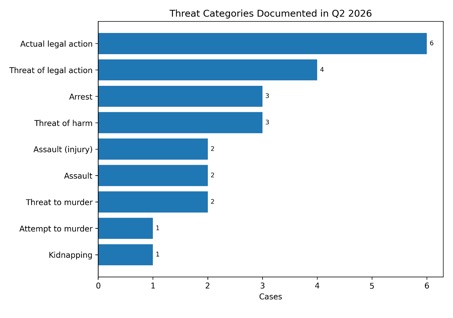
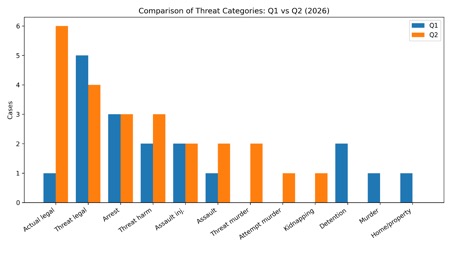
The documented cases covered a wide range of violations against journalists, including actual legal action (six), threat of legal action (four), arrest (three), assault resulting in injury (two), assault without injury (two), threat of harm (three), threat to murder (two) and attempt to murder and kidnapping (one case in each category).
The most significant trend observed during the second quarter was the continued use of legal mechanisms and state institutions to investigate, prosecute, or intimidate journalists, particularly those reporting through digital platforms or covering governance, corruption, and matters of public interest. State actors were identified as the principal threat actors in 15 out of 22 documented cases (68%), underscoring the growing role of legal and administrative measures in restricting freedom of the press.
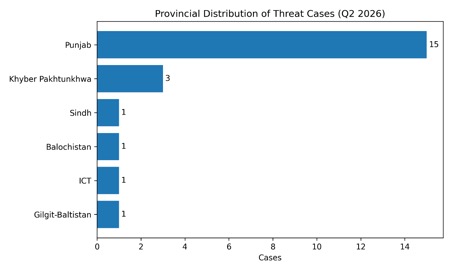
Geographically, Punjab remained the most dangerous province for journalists during the second quarter of 2026, accounting for 15 cases (68%), compared to eight cases recorded during the first quarter. Khyber Pakhtunkhwa retained its position as the second most affected province, although the number of documented cases declined from five in the first quarter to three (14%) in the second quarter. Sindh and Balochistan each recorded one case in both quarters, while Islamabad Capital Territory and Gilgit-Baltistan each documented one case during the second quarter. No verified incidents were reported from Azad Jammu and Kashmir during either quarter.
Methodology
Freedom Network compiled this assessment using verified monitoring and documentation conducted through the Pakistan Press Club Safety Hubs Network, a nationwide program it has been managing since 2016 in collaboration with the country’s major press clubs in Lahore, Multan, Quetta, Peshawar, Gilgit, and Muzaffarabad (AJK).
The Safety Hubs monitor violations against journalists, media workers, and media organizations while facilitating emergency assistance through the Pakistan Journalists Safety Fund (PJSF).
Quarter-on-Quarter Comparison
Compared to the first quarter of 2026, which documented 18 threat cases against journalists, the second quarter recorded 22 cases, reflecting an increase of 22 percent in documented violations. Punjab registered the highest number of cases in the first two quarters of 2026, increasing from eight cases in the first quarter to 15 cases in the second quarter. Khyber Pakhtunkhwa retained its position as the second most dangerous province for journalism, recording five cases during the first quarter and three cases during the second quarter. Meanwhile, Sindh, Baluchistan, Islamabad Capital Territory, and Gilgit-Baltistan continued to record isolated but significant incidents.
Key Trends
The second quarter demonstrated a continued pattern of legal action, arrests, and administrative measures targeting journalists, particularly those reporting on governance, accountability, corruption, and other matters of public interest.
Several journalists faced investigations or criminal proceedings under the Prevention of Electronic Crimes Act (PECA), anti-terrorism legislation, and other criminal laws. Cases involving Fakhar ur Rehman, Razi Tahir, Adnan Rawat, Arslan Shaukat Mahandrah, Maqbool Jaffar, Imtiaz Chandio, Muhammad Saad, Abdul Sattar Baloch, Habibullah Malik, and Shakeel Ahmad Baloch reflected a continuing pattern in which legal and regulatory mechanisms were used following journalistic reporting or online expression.
Physical violence also remained a serious concern throughout the second quarter of 2026. Journalists Abdul Ghafar survived an attempted murder in Vehari district in Punjab province, while Mian Zahid Owaisi suffered serious injuries after being attacked in Bahawalpur district, also in Punjab province. Other incidents involving Shakeel Ahmad, Hidayat Ullah, and Amir Chand Khan demonstrated that journalists covering corruption, crime, governance, and local administrative affairs continued to face violence and intimidation during field reporting.
“I believe I was targeted because of my reporting. A group of attackers assaulted me with sticks and clubs, leaving me seriously injured,” journalist Mian M. Zahid Owaisi spoke with Freedom Network to describe the situation he faced unexpectedly while reporting.
Threats against journalists investigating corruption and abuse of authority remained widespread. Several journalists received death threats or intimidation after publishing investigative reports concerning government institutions, local administrations, and public officials, reinforcing concerns over increasing hostility toward accountability journalism.
The quarter also reflected growing pressure on digital journalists, YouTubers, freelancers, and social media commentators, indicating that online journalism remains particularly vulnerable to criminal prosecution and regulatory actions.
Gender Dimension
The overwhelming majority of documented cases during the second quarter involved male journalists. No verified case involving a woman journalist was documented during the reporting period. Nevertheless, Freedom Network continues to monitor gender-specific risks affecting women journalists, recognizing that underreporting and online harassment remained significant concerns.
Notable Incidents / Case Studies
Several incidents documented during the quarter illustrate the diverse threats confronting journalists across Pakistan.
One of the most significant cases involved Adnan Rawat, a journalist and vlogger from Gilgit-Baltistan, who remained in prolonged detention under anti-terrorism and criminal provisions following allegations related to social media reporting. His extended physical remand attracted strong criticism from journalist organizations, which described the proceedings as disproportionate and harmful to press freedom.
Another important case involved Razi Tahir, who was arrested in Islamabad after his pre-arrest bail was dismissed in a PECA-related case concerning an alleged social media post. The case renewed concerns over the increasing use of cybercrime legislation against journalists engaged in online reporting and commentary.
In Punjab, Abdul Ghafar, Chief Reporter of Daily BBC News, survived an alleged attempted murder after armed attackers entered his residence and violently assaulted him. The incident highlighted the continued risks faced by local journalists reporting criminal activities and influential groups.
Provincial Distribution of Threat Cases:
Threat Categories Documented in Q2 2026:
Comparison of Threat Categories: Q1 vs Q2 (2026):
Threat Actors
Threat actors believed to have influenced these incidents include state actors, non-state actors, criminal gangs, political parties, and unknown perpetrators.
Out of the 22 documented cases, state actors accounted for 15 cases (68%), remaining as the principal source of threats against journalists. The quarterly breakdown is as follows: State actors: 15 cases (68%), non-state actors: 4 cases (18%), criminal gangs: 2 cases (9%), political party: 1 case (5%), and unknown perpetrators: 1 case (5%).
The findings demonstrate that while physical attacks by criminal and non-state actors continue to pose significant risks, legal actions, arrests, investigations, and administrative actions initiated by state institutions remained the dominant pattern of threats documented during the second quarter of 2026.
Recommendations
Freedom Network urges federal and provincial governments, law enforcement agencies, judicial authorities, parliamentarians, media organizations, and civil society to strengthen coordinated efforts aimed at protecting journalists and ending impunity for crimes against media professionals.
Freedom Network reiterates its call for reforms to laws frequently invoked against journalists, including provisions relating to cybercrime and criminal prosecution, to ensure full compliance with constitutional guarantees of freedom of expression and Pakistan’s international human rights obligations.