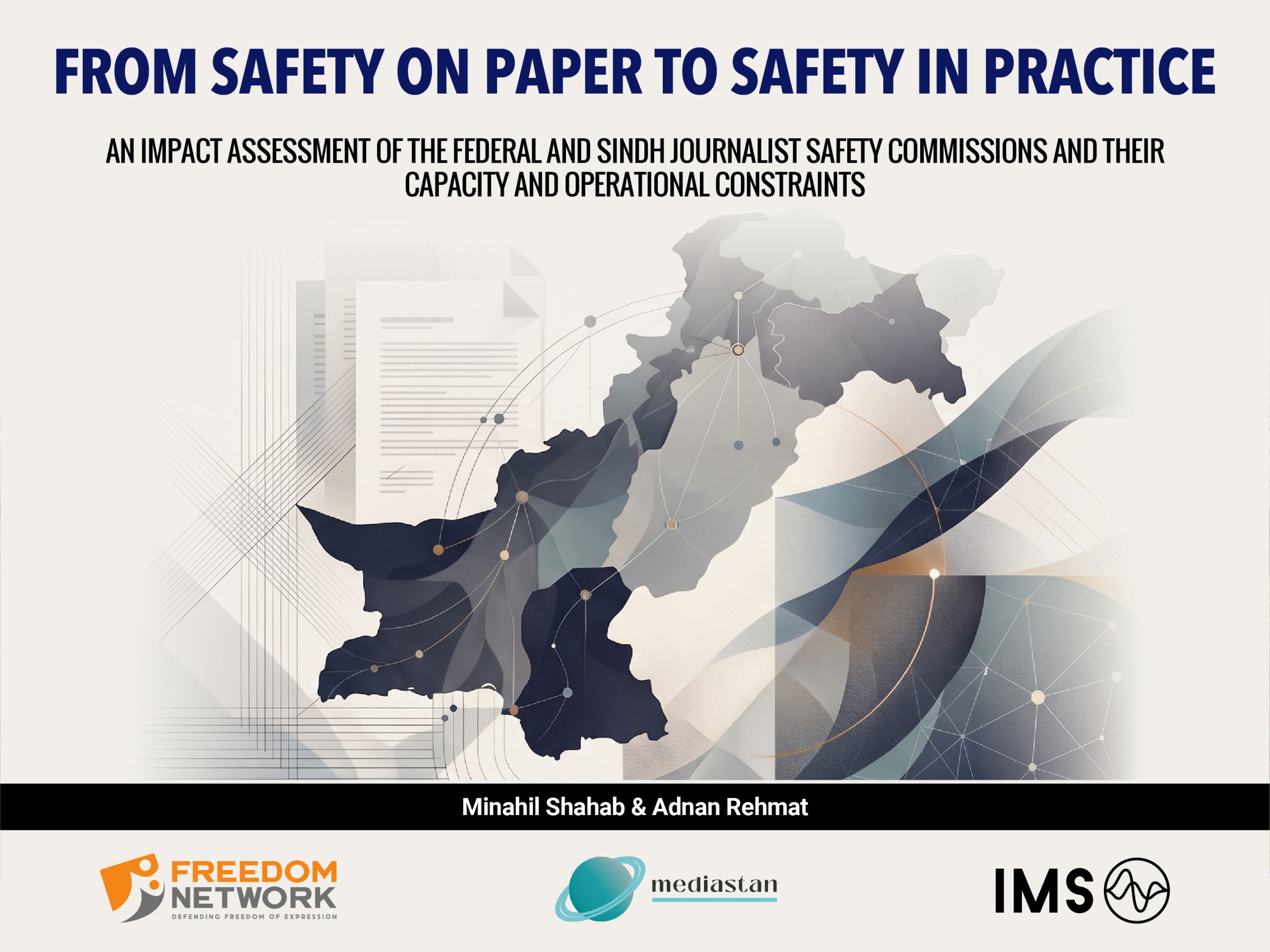
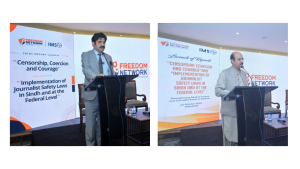
ISLAMABAD, 22 October 2026: Freedom Network today launched “From Safety on Paper to Safety in Practice,” an assessment of the federal and Sindh journalist safety commissions that calls for stronger institutional capacity, accessible complaint channels and measurable protection outcomes.
Islamabad-based media watchdog Freedom Network produced the research with support from International Media Support (IMS), according to a press release issued here on Wednesday.
The report was launched in Urdu and English languages.
Authored by Minahil Shahab and Adnan Rehmat, the report examines the commissions’ capacity and operational constraints through stakeholder consultations, interviews and a baseline online survey of approximately 40 working journalists in Sindh, including respondents from interior and rural areas.
Pakistan enacted two special laws on protection of journalists to combat impunity for crimes against journalists and media in 2022. Both the federal and Sindh government instituted commissions under the law to enforce the laws.
The online survey found that 70% of respondents knew a provincial protection law existed, but 65% did not know where to find the Commission’s office, contact information, website or complaint route. Sixty-five percent reported experiencing work-related threats or interference since 2021. These findings describe the surveyed group rather than establish province-wide prevalence.
The assessment identifies distinct institutional challenges. Federal Commission chairperson Kamal Uddin Tipu described staffing, budget, premises and administrative constraints during the research. With the federal Commission now operational, the priority is to ensure that its personnel, resources and complaint systems support timely protection and sustained follow-up.
In Sindh, the report documents an established institution with premises, meetings, complaints and engagement with police and media organizations. However, union representatives and nonofficial members described delayed responses, limited outreach beyond Karachi and dependence on police replies.
Sindh Commission chairperson Aijaz Ahmed Memon disputed suggestions that journalists lacked trust in the institution and reported improvements in coordination, case activity and outreach plans.
The report also highlights media employers’ responsibilities. Fifty-one percent of survey respondents said employers had not informed them about safety procedures, emergency contacts, insurance, legal assistance or complaint mechanisms. The Sindh chairperson separately reported that 44 media outlets had not answered Commission inquiries.
Recommendations include confidential and accessible complaint routes, urgent risk assessment, designated caseworkers, police escalation procedures, stronger employer cooperation and publication of anonymized outcomes and spending. The report also urges carefully framed amendments to address documented legal barriers.
Its central test is practical: whether Commission intervention makes a journalist safer, improves an investigation, secures employer support or obtains accountability. Freedom Network called for coordinated action by governments, commissions, police, media employers and journalist organizations to deliver those results and ensure that journalists can obtain effective assistance when threats arise.
Click below links to download English version report
https://fnpk.org/wp-content/uploads/2026/10/Censorship-Coercion-And-Courage.pdf
Click below links to download Urdu version report
https://fnpk.org/wp-content/uploads/2026/10/سنسرشپ،-جبر-اور-جرات.pdf